
BAYPAYO Q Heat 5.5 US – High-Precision Ultrasonic Heat Meter
Last updated: August 8, 2026
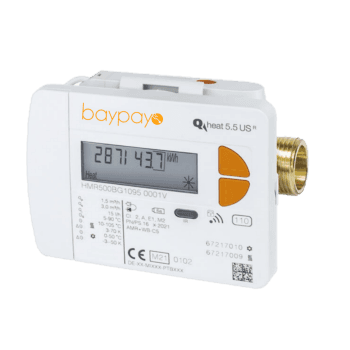
The BAYPAYO Q Heat 5.5 US is a high-precision, Made in Germany ultrasonic heat meter engineered for accurate central heating submetering, featuring IP65 protection, a 1:100 dynamic range, up to 10 years of battery life, and seamless compatibility with M-Bus, AMR, and Walk-by remote reading systems for effortless energy management.
BAYPAYO Q Heat 5.5 US Ultrasonic Heat Meter – High-Precision Thermal Energy Meter
BAYPAYO Q Heat 5.5 US is a next-generation ultrasonic heat meter (BTU meter) developed for precise, reliable, and long-lasting measurement of heat consumption in hydronic central heating systems.
Engineered with "Made in Germany" technology, the BAYPAYO Q Heat 5.5 US meets the requirements of modern central heating systems thanks to its high measurement accuracy, compact design, low starting flow rate, wide dynamic measuring range, IP65 protection class, and flexible communication options compatible with various Automatic Meter Reading (AMR) systems.
Particularly preferred in multi-family residential buildings, gated communities, high-rises, commercial buildings, and central heating projects, the Baypayo Q Heat 5.5 US heat meter enables individual thermal energy metering for each independent unit and ensures heat cost allocation based on actual consumption.
By utilizing ultrasonic flow measurement technology, it eliminates moving parts commonly found in mechanical multi-jet or single-jet meters, thereby minimizing mechanical wear and measurement inaccuracies, while its high-grade construction ensures reliable long-term performance.
What is the BAYPAYO Q Heat 5.5 US?
The BAYPAYO Q Heat 5.5 US is an ultrasonic heat energy meter used to measure the thermal energy delivered by hot water to an individual unit within a central heating system.
Heat meters calculate consumed heat energy by evaluating the volumetric flow rate of the circulating fluid and the temperature differential ($\Delta T$) between the supply (flow) and return pipes.
The BAYPAYO Q Heat 5.5 US executes this calculation utilizing state-of-the-art ultrasonic transit-time technology.
Consequently, this device functions as an:
- Ultrasonic Heat Meter
- Ultrasonic BTU Meter
- Thermal Energy Meter
- Central Heating Submeter
- Remote Reading Heat Meter
- M-Bus Compatible Heat Meter
Because precise submetering is critical in modern heat cost allocation systems, the meter’s accuracy, lifespan, data communication capabilities, and installation flexibility play a vital role in overall system performance.
Next-Generation Ultrasonic Heat Meter Technology
Unlike mechanical meters with impellers or turbines, ultrasonic heat meters perform flow measurement using ultrasonic transit-time principles.
The BAYPAYO Q Heat 5.5 US features advanced metering technology specifically engineered for central heating applications requiring high precision.
Accurately capturing low flow rates is a critical selection criterion for submetering equipment. Because consumption profiles vary across different apartments in centralized systems, heat meters must deliver reliable results across a wide dynamic range.
The engineered sensing architecture of the BAYPAYO Q Heat 5.5 US provides distinct operational advantages:
- Low starting flow rate detection
- Wide dynamic measuring range
- Fast measurement cycle
- High-precision temperature sensing
- Long-term operational stability
- Multi-position installation capability
These capabilities make the Baypayo ultrasonic heat meter an ideal metering solution for both new construction projects and retrofit upgrades of existing central heating systems.
Reliable Thermal Energy Measurement via High-Precision Sensing
The primary function of a heat meter is to measure consumed thermal energy with maximum accuracy.
Because submetering readings directly dictate utility cost allocation in central heating systems, measurement fidelity is paramount.
The BAYPAYO Q Heat 5.5 US incorporates a specialized ultrasonic flow sensor assembly that detects low flow conditions.
Its patented measurement method and high-grade sensing components maintain stable operational performance throughout the device's service life.
This engineering makes the BAYPAYO Q Heat 5.5 US a robust option for projects requiring:
- High-quality heat meters
- Precision energy meters
- Long-life BTU meters
- Dependable ultrasonic submeters
Contaminant and Fouling-Resistant Measurement Design
Particulates, rust scale, and system debris circulating in heating hydronic loops can degrade metering accuracy over time.
The high-grade materials and fouling-resistant flow channel of the BAYPAYO Q Heat 5.5 US help preserve measurement integrity during long-term operation.
The patented ultrasonic transit-time path minimizes the adverse effects of scaling and internal contamination buildup on acoustic transducer signals.
This feature provides a distinct operational advantage in central heating loops expected to run continuously for years.
Long-Life Heat Metering Solution
Heat meters are expected to operate continuously for many years without failure.
Therefore, selecting a meter requires looking beyond initial procurement cost and evaluating key lifecycle parameters:
- Measurement accuracy class
- Build quality and materials
- Battery lifespan
- Ingress protection (IP rating)
- Communication protocol support
- After-sales technical service
- Warranty coverage
- Long-term drift performance
The BAYPAYO Q Heat 5.5 US is engineered for extended operational cycles, featuring a battery service life of up to 10 years and a rugged housing.
This long battery lifespan reduces maintenance cycles and battery replacement overhead, particularly in large-scale installations with hundreds or thousands of submetered units.
Compact Design for Tight Installation Spaces
A common challenge during heat meter installation is restricted physical space within mechanical enclosures.
Compact submeter dimensions provide a significant installation advantage in tight locations such as:
- Heat Interface Units (HIU)
- Meter manifolds and cabinets
- Utility shafts / risers
- Apartment entryways
- Mechanical closets
- Central mechanical rooms
The BAYPAYO Q Heat 5.5 US is designed with a small footprint and low overall height to facilitate installation in confined spaces.
This compact envelope simplifies integration into specialized piping layouts, including Heat Interface Unit (HIU) assemblies.
Flexible Multi-Position Mounting Options
A key feature of the BAYPAYO Q Heat 5.5 US is its installation flexibility.
The heat meter can be installed in various spatial orientations depending on site conditions.
Its certified horizontal and vertical mounting versatility is particularly useful in Heat Interface Units (HIU) and constrained mechanical piping layouts.
This versatility simplifies piping design and spatial planning during the engineering phase.
During physical installation, installers must strictly adhere to the flow direction arrow, straight pipe run requirements, and the manufacturer's technical manual.
Detachable Integrator / Calculator Unit
The BAYPAYO Q Heat 5.5 US comes standard with a detachable calculator (integrator) unit.
This modular construction simplifies mounting, wiring, and servicing inside congested manifolds or utility cabinets.
Separating the electronic display unit from the flow sensor body allows remote mounting for easier display reading and routine technical inspections when physical access to the pipe section is restricted.
Integration with Remote Meter Reading Systems (AMR / AMI)
Modern commercial and multi-family residential developments rely on Automated Meter Reading (AMR) and Advanced Metering Infrastructure (AMI) rather than manual door-to-door inspections.
The BAYPAYO Q Heat 5.5 US supports multiple add-on communication modules, enabling central system software to collect and analyze energy consumption data automatically.
Automated remote reading benefits utility operators by:
- Reducing billing collection time
- Eliminating manual transcription errors
- Centralizing consumption data aggregation
- Eliminating the need for physical access to private residential quarters
- Streamlining operational workflows in large developments
In large residential complexes, automated heat meter reading provides essential operational efficiencies for building management.
M-Bus Heat Meters and AMR Infrastructures
Within the Baypayo system architecture, the BAYPAYO Q Heat 5.5 US seamlessly integrates with various communication and submetering networks, supporting:
- Q M-Bus (Wired M-Bus protocol)
- Q AMR (Automated Meter Reading systems)
- Q Walk-by (Wireless Mobile Meter Reading)
M-Bus (Meter-Bus, EN 13757) is a widely adopted standard protocol for heat energy meters, enabling data transfer to central Building Management Systems (BMS) or utility billing platforms.
As a result, the BAYPAYO Q Heat 5.5 US operates both as a standalone heat meter and as an integrated endpoint within centralized energy management systems.
Centralized Heat Cost Allocation with BAYPAYO
Measuring thermal energy consumption per unit in central heating systems establishes a transparent basis for utility cost tracking and submetering.
The meters measure energy usage per individual zone or apartment.
When combined with remote reading infrastructure, consumption data from the BAYPAYO Q Heat 5.5 US streams directly into central billing software.
This forms a complete operational chain:
$$\text{Heat Meter} \longrightarrow \text{AMR / Communication Infrastructure} \longrightarrow \text{Central Software} \longrightarrow \text{Data Analytics} \longrightarrow \text{Heat Cost Allocation}$$
Thus, Baypayo meters serve as critical assets within modern smart energy and building automation networks.
BAYPAYO Q Heat 5.5 US Technical Specifications
ParameterSpecification / DetailsProduct CategoryUltrasonic Heat Meter / Thermal Energy MeterOriginMade in GermanyFlow Measurement MethodUltrasonic Transit-TimeTemperature Sensor TypePt1000 Platinum Resistance ElementsIngress Protection ClassIP65Starting Flow Rate ($q_s$)$3\text{ l/h}$Dynamic Range ($q_p / q_i$)1:100 ($R100$)Accuracy ClassClass 3 (EN 1434)Measurement Cycle RateDown to 12 secondsCalculator UnitDetachable / Split-Mount CapableCommunication OptionsQ M-Bus, Q AMR, Q Walk-byPower Supply / Battery LifeUp to 10 years (Lithium Battery)Installation OrientationMulti-position (Horizontal & Vertical)Application FieldHydronic Central Heating SystemsTemperature Sensor Diameter$5.0\text{ mm} / 5.2\text{ mm}$ Direct InsertionSensor Cable Lengths$1.5\text{ m} / 3\text{ m}$
Installation Dimensions / Nominal Flow Rates:
- $q_p\ 1.5\text{ m}^3\text{/h}$: $110\text{ mm}$ overall length
- $q_p\ 2.5\text{ m}^3\text{/h}$: $130\text{ mm}$ overall length
Note: Technical specifications may vary depending on model configuration. Always consult the official product datasheet prior to project installation.
Fast Measurement Cycle
A key technical feature of the BAYPAYO Q Heat 5.5 US is its rapid measurement cycle, which updates in intervals as short as 12 seconds.
This high sampling rate tracks dynamic changes in flow and temperature rapidly, responding swiftly to fluctuating hydraulic conditions.
This feature is beneficial in dynamic heating circuits with rapid control valve modulations.
1:100 Dynamic Measurement Range
A critical parameter in meter selection is the turndown ratio across flow ranges.
The BAYPAYO Q Heat 5.5 US features a dynamic range of 1:100 ($R100$).
This wide measurement span allows accurate metering across both low shoulder-season flows and peak winter demand loads, ensuring precise heat cost allocation year-round.
IP65 Ingress Protection Class
The BAYPAYO Q Heat 5.5 US carries an IP65 protection rating, safeguarding the electronic assemblies against dust ingress and low-pressure water jets common in mechanical rooms, shafts, and utility boxes.
Proper installation practices following manufacturer guidelines preserve this IP rating in demanding operational environments.
Primary Applications of the BAYPAYO Q Heat 5.5 US
The BAYPAYO Q Heat 5.5 US is designed for a variety of hydronic heating submetering applications:
- Apartment Buildings: Submetering heat consumption per dwelling in central heating loops.
- Gated Communities & Multi-Family Housing: Integrated remote reading capabilities streamline centralized consumption monitoring across large residential developments.
- High-Rise Residences: Compact design and flexible protocol modules suit modern residential towers.
- Heat Interface Units (HIU): Small footprint and multi-position mounting allow direct integration inside compact HIU cabinets.
- Commercial Buildings: Submetering offices, retail centers, and mixed-use commercial space fed by central boiler plants.
- Building Energy Management Systems (BEMS): M-Bus, AMR, and Walk-by capabilities integrate energy data into facility management networks.
Key Considerations When Selecting a Heat Meter
Choosing the correct heat meter involves evaluating system parameters beyond initial procurement cost:
- Measurement Accuracy & Class: Evaluate low-flow and peak-flow accuracy profiles against EN 1434 standards.
- Measurement Technology: Determine whether mechanical single/multi-jet or ultrasonic flow measurement suits system water quality.
- Dynamic Range (Turndown Ratio): Select meters with wide dynamic ranges (e.g., 1:100) to capture low consumption during shoulder seasons accurately.
- Communication Protocols: Ensure compatibility with project AMR/AMI networks (e.g., M-Bus, Wireless M-Bus, Walk-by).
- Battery Service Life: Long battery life lowers operational maintenance and field service expenditures over time.
- Physical Dimensions & Clearance: Verify compact dimensions for installations in confined manifolds or HIUs.
- Technical Support & Warranty: Confirm post-purchase engineering support, recalibration services, and coverage terms.
Why Choose the BAYPAYO Q Heat 5.5 US?
- Made in Germany technology
- State-of-the-art ultrasonic measurement
- High accuracy class compliance
- 1:100 dynamic measuring range
- Low $3\text{ l/h}$ starting flow sensitivity
- Fast measurement cycle (down to 12 seconds)
- IP65 enclosure protection
- Compact form factor for tight spaces
- Multi-position mounting versatility (horizontal/vertical)
- Detachable calculator / integrator unit
- High-precision Pt1000 temperature sensors
- Up to 10-year battery lifespan
- Native M-Bus compatibility
- Seamless AMR network integration
- Wireless Walk-by mobile reading support
- Compatible with remote submetering infrastructures
- 5-year manufacturer warranty
- Comprehensive technical support network
BAYPAYO Heat Meters – 5-Year Warranty & Technical Support
As a core measurement device in central heating infrastructure, a heat meter must deliver long-term operational dependability.
Therefore, technical service and local engineering support are as crucial as device specifications.
The BAYPAYO Q Heat 5.5 US comes with a 5-year manufacturer warranty.
Supported by an established distributor and service network, warranty claims, field support, and technical assistance are managed efficiently according to service guidelines.
Baypayo: Trusted Solutions in Heat Submetering Technologies
BAYPAYO specializes in thermal energy meters, submetering solutions, heat cost allocators, automated reading systems, and energy management technology.
The BAYPAYO Q Heat 5.5 US combines precise measurement, extended service life, compact physical dimensions, and remote reading capabilities into a single ultrasonic submetering solution.
In centralized hydronic heating, accurate metering supports energy conservation, fair utility cost allocation, and efficient resource monitoring.
Achieving these goals requires pairing high-grade heat meters with properly engineered hydronic piping and reliable automated reading systems.
Frequently Asked Questions (FAQ)
What is a heat meter?
A heat meter (also referred to as a BTU meter or thermal energy meter) is a device that measures the thermal energy consumed in a hydronic heating circuit by monitoring fluid flow rate and supply/return fluid temperature differentials.
What is an ultrasonic heat meter?
An ultrasonic heat meter measures fluid flow rate using ultrasonic transit-time acoustic signals rather than moving mechanical impellers or turbines, eliminating mechanical wear components.
Where is the BAYPAYO Q Heat 5.5 US manufactured?
The BAYPAYO Q Heat 5.5 US is engineered and manufactured utilizing "Made in Germany" production technology.
Can the Baypayo heat meter be read remotely?
Yes. When equipped with compatible communication modules, the Q Heat 5.5 US operates within Q M-Bus, Q AMR, and Q Walk-by automated reading networks.
How does remote heat meter reading work?
Remote systems transmit logged consumption parameters from the meter's register across a wired (M-Bus) or wireless (RF/Wireless M-Bus) network to a central receiver or software platform for automated utility billing.
What is the battery life of the BAYPAYO Q Heat 5.5 US?
The device is powered by an internal lithium battery designed to last up to 10 years, depending on operating conditions, update intervals, and installed communication modules.
Can this heat meter be installed horizontally?
Yes. The BAYPAYO Q Heat 5.5 US supports multi-position mounting, including horizontal and vertical orientations, provided manufacturer piping and orientation guidelines are followed.
What is the warranty period for the BAYPAYO Q Heat 5.5 US?
The meter includes a 5-year manufacturer warranty.
What building types use ultrasonic heat meters?
They are used in multi-family apartments, residential complexes, high-rise condominiums, commercial offices, retail centers, and any facility utilizing centralized hydronic heating submetering.
Conclusion: Precision Submetering for Modern Energy Infrastructure
The BAYPAYO Q Heat 5.5 US provides a precise, reliable submetering solution for central heating applications.
Its Made in Germany engineering, patented ultrasonic flow path, compact enclosure, multi-position installation, 1:100 dynamic range, low starting flow rate, IP65 protection, 10-year battery life, and AMR/M-Bus integration options make it a complete submetering solution.
Whether specified for new construction or system retrofits, the Baypayo Q Heat 5.5 US offers the performance and connectivity required for modern heat cost allocation and centralized energy management.