
Underfloor Heating System: Complete Guide
Last updated: August 31, 2026
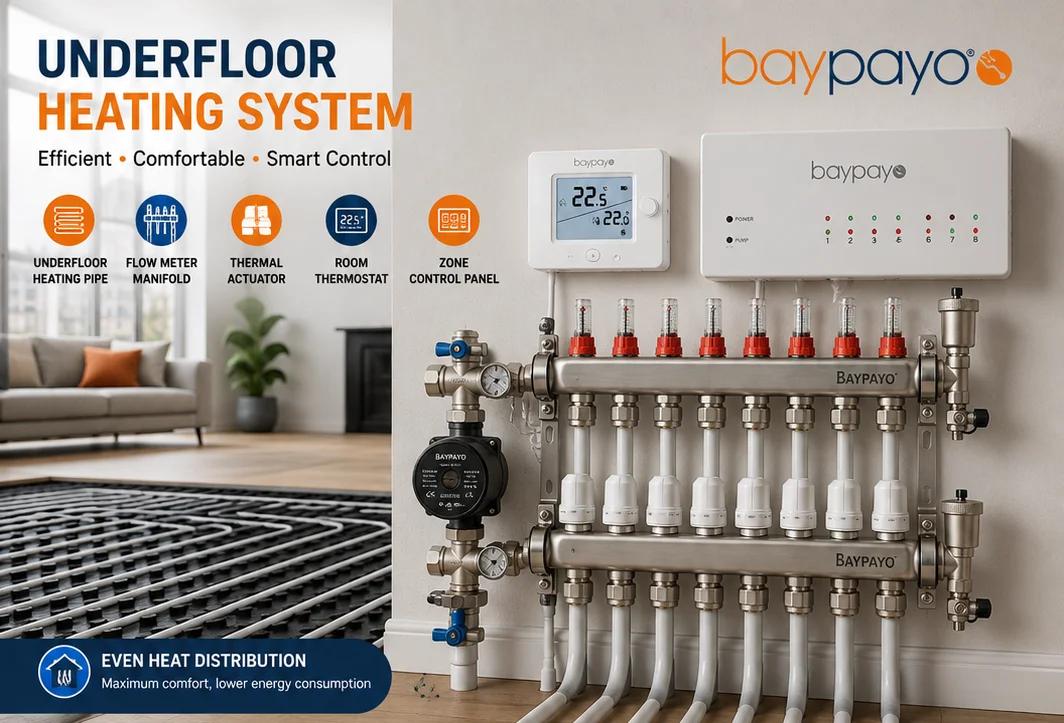
For residential developments and central heating projects, Baypayo's product portfolio can provide solutions covering different parts of the system, including Heat Interface Units (HIUs), room thermostats, flow meter manifolds, thermal actu…


What Is Underfloor Heating?
Underfloor heating is a heating system in which heat is transferred from the floor to the room.
In a hydronic system, warm water circulates through specially designed pipes installed beneath the floor. Heat from the water passes through the pipe, screed and floor covering and is gradually transferred into the room.
The basic operating principle is:
Heat Source → Circulation Pump → Manifold → Heating Circuits → Floor → Room
Modern systems can also include room-by-room temperature control:
Room Thermostat → Wiring Centre → Thermal Actuator → Manifold → Heating Circuit
This allows individual rooms or heating zones to be controlled according to their temperature requirements.
Underfloor heating can therefore be considered not only a heating distribution method, but also a complete system consisting of heat distribution, hydraulic balancing, temperature control and energy management.
How Does Underfloor Heating Work?
In a hydronic underfloor heating system, heated water is supplied to the underfloor heating manifold.
The manifold distributes the water to individual heating circuits.
Each circuit normally serves a defined area of the building. For example, a house may have separate circuits for:
- Living room
- Kitchen
- Hallway
- Bedroom
- Children's room
- Bathroom
The warm water flows through the pipes installed beneath the floor and transfers heat to the surrounding floor construction.
After passing through the heating circuit, the cooler water returns to the manifold and is then circulated back toward the heat source.
Room-by-Room Temperature Control
Modern underfloor heating systems can be divided into individual heating zones.
A room thermostat measures the temperature in each zone.
When the room temperature falls below the set point, the thermostat sends a signal to the heating control system. The corresponding thermal actuator opens the relevant manifold circuit.
When the desired temperature is reached, the control system can close the circuit.
This provides individual room temperature control rather than operating the entire heating system at the same temperature.
Advantages of Underfloor Heating
Underfloor heating provides several advantages compared with conventional radiator heating when the system is properly designed and installed.
Even Heat Distribution
One of the main advantages of underfloor heating is the large heating surface.
Instead of concentrating heat around a radiator, the floor becomes the heat-emitting surface.
This can help create a more uniform temperature distribution throughout the room.
Comfortable Indoor Temperature
Because heat is distributed over a large surface area, underfloor heating can provide a comfortable and consistent indoor environment.
The floor itself becomes part of the heating system, which can be particularly comfortable in living rooms, bedrooms, bathrooms and other areas where people spend considerable time.
Low-Temperature Heating
Hydronic underfloor heating systems are generally designed to operate with lower water temperatures than many traditional radiator systems.
This characteristic makes underfloor heating particularly suitable for modern low-temperature heating technologies.
It can be an attractive combination with systems such as:
- Heat pumps
- Condensing boilers
- Low-temperature heating systems
- Central heating systems designed for low-temperature operation
No Wall-Mounted Radiators
Because the floor provides the heating surface, conventional radiators are not required in the room.
This can provide greater freedom for:
- Furniture placement
- Interior design
- Wall space
- Large windows
- Modern architectural layouts
Individual Room Control
With room thermostats and thermal actuators, different rooms can be controlled independently.
A bedroom, living room and bathroom do not necessarily need to operate at exactly the same temperature.
This allows the heating system to respond to the actual requirements of each zone.
Suitable for Modern Buildings
Underfloor heating is particularly suitable for new buildings where the floor construction, insulation and heating system can be designed together from the beginning.
Disadvantages of Underfloor Heating
Underfloor heating also has some limitations that should be considered before installation.
Higher Initial Installation Cost
The initial cost may be higher than a basic radiator system because an underfloor heating system can require:
- Underfloor heating pipes
- Insulation
- Manifold
- Flow meters
- Thermal actuators
- Room thermostats
- Wiring centre
- Pumps
- Controls
- Installation labour
The actual cost depends on the design and scope of the project.
Slower Temperature Response
Underfloor heating generally has a slower response compared with a conventional radiator.
This is because the floor structure acts as a thermal mass.
For this reason, underfloor heating is usually better suited to stable and controlled operation rather than frequent large temperature changes.
More Difficult to Retrofit
Installing underfloor heating in an existing building can be more complicated.
Depending on the floor construction, the existing screed may need to be removed, the floor level may need to be raised, or a low-profile retrofit system may be required.
Installation Quality Is Critical
Once the floor has been completed, most of the heating pipes are no longer easily accessible.
Therefore, proper system design, pressure testing, installation and commissioning are extremely important.
Underfloor Heating vs Radiator Heating
One of the most common questions from homeowners is:
Is underfloor heating better than radiators?
There is no universal answer.
Both systems can provide effective heating when correctly designed.
The right choice depends on:
- Building insulation
- Heat loss
- Heat source
- Floor construction
- Building type
- Room usage
- Installation budget
- Desired comfort level
- Temperature control requirements
FeatureUnderfloor HeatingRadiator HeatingHeating surfaceLarge floor areaIndividual radiatorsHeat distributionGenerally more uniformConcentrated around radiatorsOperating temperatureGenerally lowerGenerally higherRoom controlExcellent with UFH controlsPossible with thermostatic valves/controlsResponse timeSlowerFasterWall spaceNo radiators requiredRadiator space requiredNew constructionExcellentSuitableRetrofitMore complexGenerally easierHeat pump compatibilityVery good when properly designedDepends on system designInitial investmentCan be higherOften lowerInterior designGreater flexibilityRadiator positions must be considered
Underfloor Heating vs Radiators: Comfort Comparison
Comfort is one of the main reasons people choose underfloor heating.
A radiator heats the surrounding air from a relatively small surface.
Underfloor heating uses a much larger surface area.
As a result, the heating effect can be distributed more evenly throughout the room.
This does not mean that radiator heating is uncomfortable. A properly designed radiator system can also provide excellent comfort.
The difference is primarily in how heat is distributed.
Underfloor Heating vs Radiators: Cost Comparison
The initial installation cost of a radiator system can be lower because the system is relatively simple.
Underfloor heating normally requires additional components and installation work.
However, comparing only the initial installation price does not provide a complete picture.
The long-term performance of a heating system depends on:
- Building insulation
- Heat source efficiency
- Operating temperature
- Heating controls
- Pump efficiency
- User behaviour
- Maintenance
- System design
Therefore, the better question is not simply:
“Which system is cheaper?”
It is:
“Which heating system is more suitable for this building over its expected service life?”
Components Used in an Underfloor Heating System
A hydronic underfloor heating system consists of several components working together.
The main components include:
- Underfloor heating pipe
- Thermal insulation
- Perimeter insulation
- Underfloor heating manifold
- Flow meters
- Thermal actuators
- Room thermostats
- Wiring centre
- Circulation pump
- Manifold cabinet
- Valves and fittings
- Heat source
- Heating controls
The exact configuration depends on the size and design of the project.
Underfloor Heating Pipe
The underfloor heating pipe carries the warm water through the floor.
Common pipe technologies include suitable grades of:
- PEX
- PE-RT
- Multilayer pipe systems
The correct pipe should be selected according to the required operating temperature, pressure, installation method and manufacturer's specifications.
Pipe diameter and spacing should also be determined according to the heating design.
Underfloor Heating Manifold
The underfloor heating manifold is the distribution centre of the system.
It distributes heated water to individual heating circuits and collects the return water.
A manifold can include:
- Flow meters
- Flow control valves
- Isolation valves
- Actuator connections
- Air vents
- Drain/fill points
- Temperature gauges
The number of manifold outlets depends on the number of heating circuits.
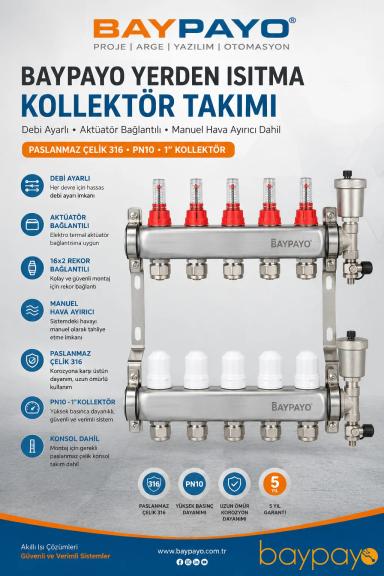
Flow Meter Manifold
A flow meter manifold allows the water flow rate through each heating circuit to be monitored and adjusted.
This is important because different heating circuits can have different lengths and heat requirements.
For example, a large living room may require a longer circuit than a small bathroom.
Without proper hydraulic balancing, some circuits may receive too much water while others may receive insufficient flow.
Flow meters make system balancing easier.
Thermal Actuator
A thermal actuator is used to control an individual heating circuit on the manifold.
The actuator receives a signal from the heating control system.
Depending on the control signal, it opens or closes the relevant manifold circuit.
This allows individual heating zones to be controlled automatically.
The typical control sequence is:
Room Thermostat → Wiring Centre → Thermal Actuator → Manifold Circuit
Room Thermostat
A room thermostat measures the temperature of a room and compares it with the desired temperature set point.
For example, if the target temperature is 22°C, the thermostat monitors the room and requests heating when the temperature falls below the required level.
Room thermostats can be:
- Wired
- Wireless
- Digital
- Programmable
- Smart, depending on the system
For underfloor heating, thermostat selection should be compatible with the thermal actuators and control system.
Thermal Insulation
Thermal insulation beneath the heating pipes helps reduce downward heat loss.
The insulation specification should be selected according to:
- Building regulations
- Floor construction
- Thermal requirements
- Project design
- Local climate
- Manufacturer recommendations
Good insulation is an important part of an efficient underfloor heating installation.
Perimeter Insulation Strip
A perimeter insulation strip is installed around the edges of the heated floor area.
It helps accommodate thermal movement of the screed and reduces direct thermal transfer between the floor structure and surrounding walls.
Circulation Pump
The circulation pump moves heating water through the system.
Pump selection should be based on the required flow rate and system pressure loss.
An incorrectly sized pump can cause poor circulation, unnecessary energy consumption or hydraulic imbalance.
Underfloor Heating Installation: What Should You Consider?
A professional underfloor heating installation should start with system design rather than material selection.
Heat Loss Calculation
The first step is determining the heating requirement of the building.
Heat loss depends on factors such as:
- External walls
- Windows
- Roof
- Floor
- Building orientation
- Insulation
- Outdoor design temperature
- Internal room conditions
Each room can have a different heat load.
Therefore, designing an underfloor heating system simply by multiplying the floor area by a fixed number is not an accurate engineering method.
Pipe Spacing
Pipe spacing is the distance between adjacent underfloor heating pipes.
Closer pipe spacing can increase the heat output of the floor, while wider spacing reduces pipe quantity.
The correct spacing depends on:
- Room heat load
- Floor construction
- Water temperature
- Floor covering
- Insulation
- Design requirements
Therefore, pipe spacing should be calculated rather than selected arbitrarily.
Heating Circuit Length
Each heating circuit should be designed according to pipe diameter, flow requirement and hydraulic resistance.
Excessively long circuits can increase pressure loss and make hydraulic balancing more difficult.
For this reason, heating circuit lengths should be determined during system design.
Hydraulic Balancing
Hydraulic balancing is one of the most important aspects of an underfloor heating installation.
Different circuits can have different lengths.
If all circuits are left without proper flow adjustment, water may preferentially flow through circuits with lower resistance.
A flow meter manifold allows the installer to adjust individual circuit flow rates.
Proper hydraulic balancing helps ensure that each zone receives the required amount of heating water.
Floor Insulation
Insulation beneath the system should not be treated as an optional accessory.
Without suitable insulation, a portion of the heat may be transferred downward instead of toward the occupied space.
The insulation system should therefore be included in the original floor design.
Screed Installation
After the pipework has been installed and tested, the screed is applied according to the floor construction and project specification.
Care must be taken to avoid damaging the pipework.
The screed must also be suitable for the intended heating application.
Floor Covering Selection
The floor covering influences heat transfer.
Materials such as ceramic tiles and natural stone generally provide good thermal transfer.
Certain thick carpets or floor coverings with high thermal resistance can reduce the heat output of the floor.
The final floor covering should therefore be considered during the design stage rather than after the heating system has already been installed.
Underfloor Heating Controls and Automation
Modern underfloor heating is increasingly combined with UFH controls.
The purpose of the control system is to maintain room temperature while operating individual heating zones according to demand.
A typical system consists of:
Room Thermostat → Wiring Centre → Thermal Actuator → Manifold
The system may also control or coordinate the circulation pump and heat source depending on the design.
Wired Room Thermostat
A wired room thermostat communicates with the heating control system through a physical cable.
Wired thermostats are particularly suitable for new buildings where the electrical and control infrastructure can be planned before construction.
Advantages include:
- Reliable communication
- No wireless signal dependency
- Simple system architecture
- Suitable for new construction
Wireless Room Thermostat
Wireless room thermostats are particularly useful in existing buildings where installing new cables would be difficult.
The thermostat communicates with the receiver or control system wirelessly.
Before selecting a wireless system, the installer should consider:
- Building structure
- Concrete floors
- Walls
- Distance
- Number of floors
- Wireless communication range
Underfloor Heating Wiring Centre
The wiring centre provides the electrical connection between room thermostats and thermal actuators.
In a multi-zone system, several thermostats can be connected to the wiring centre.
The wiring centre can then control the relevant actuators according to room demand.
Depending on the system design, it may also provide pump or heat-source control.
Room-by-Room Temperature Control
One of the major advantages of modern UFH controls is individual room control.
For example:
Living Room: 22°C
Bedroom: 20°C
Bathroom: 23°C
Each room can operate according to its own requirements.
This is particularly useful in larger houses and multi-zone residential projects.
How to Install Underfloor Heating Controls
A typical room-by-room control system can be installed using the following sequence:
- Determine the heating zones.
- Select suitable room thermostats.
- Install the manifold.
- Install thermal actuators on the manifold.
- Install the wiring centre.
- Connect the room thermostats.
- Connect the actuators.
- Configure pump and heat-source control where applicable.
- Adjust manifold flow rates.
- Test each heating zone.
- Commission the system.
Correct commissioning is essential.
The system should not simply be switched on after installation and considered complete.
How Much Does a 100 m² Underfloor Heating System Cost?
The cost of a 100 m² underfloor heating system depends on the scope of the installation.
There is no single price that applies to every 100 m² project.
The total cost can change according to:
- Building type
- Net heated area
- Number of rooms
- Pipe length
- Pipe spacing
- Manifold size
- Insulation
- Thermostats
- Thermal actuators
- Wiring centre
- Pump
- Screed
- Floor preparation
- Installation labour
- Heat source
- Heat meter
- Heat Interface Unit
- Project location
Current Turkish market estimates for 2026 vary considerably depending on the scope and quality level. Some published estimates place a 100 m² hydronic underfloor heating installation roughly in the TRY 64,000–161,000 range, while other market sources calculate approximately TRY 1,350–2,150 per m² for selected material-and-labour packages. These figures should be treated as market indications rather than a fixed quotation.
The final project price should be calculated after the system design has been prepared.
What Affects the Cost of a 100 m² Underfloor Heating System?
The main cost components are:
ComponentMain cost factorsUnderfloor heating pipeType, diameter and total lengthThermal insulationThickness and specificationManifoldNumber of circuits and featuresFlow metersManifold configurationThermal actuatorsNumber of heating zonesRoom thermostatsWired/wireless and featuresWiring centreNumber of zonesManifold cabinetSize and constructionPumpFlow rate and headScreedType and thicknessInstallationProject complexityHeat sourceBoiler, heat pump, central heating etc.Heat meterMetering requirementsHIUCentral heating/project requirements
This is why searching only for “100 m² underfloor heating price” is not sufficient to determine the actual project budget.
Underfloor Heating and Energy Efficiency
The efficiency of an underfloor heating system is not determined by the pipe alone.
The overall performance depends on the complete building and heating system.
Important factors include:
- Building insulation
- Heat loss
- Water temperature
- Heat source efficiency
- Hydraulic balancing
- Pump efficiency
- Room controls
- Floor covering
- Operating strategy
A well-insulated building generally requires less heating energy than a poorly insulated building.
Therefore, improving building insulation can be just as important as selecting a high-quality heating component.
Underfloor Heating and Heat Pumps
Underfloor heating and heat pumps are often considered together because both can operate effectively with low-temperature heating.
A heat pump can produce lower-temperature heating water than many traditional boiler applications.
Because underfloor heating uses a large heat-emitting surface, it can be designed to deliver the required room heat at relatively low water temperatures.
This can create a technically suitable combination:
Heat Pump → Low-Temperature Heating Water → Underfloor Heating → Room
However, the heat pump capacity, building heat load, floor output and water temperature must be designed as one system.
Baypayo Underfloor Heating Solutions
An underfloor heating system is not simply a collection of pipes.
A modern system can include heat distribution, room temperature control, hydraulic balancing, energy measurement and central system integration.
Baypayo offers heating and measurement solutions that can be considered within this wider system architecture.
Depending on the project, Baypayo solutions may include:
- Heat Interface Unit (HIU)
- Room Thermostats
- Flow Meter Manifolds
- Thermal Actuators
- Two-Way Motorized Valves
- Heat Meters
These products should be selected according to the technical requirements of the individual project.
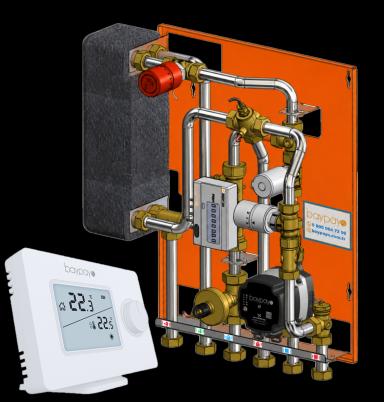
Baypayo Heat Interface Unit (HIU) for Underfloor Heating
A Heat Interface Unit (HIU) can be used in buildings supplied by a central heating network to provide an interface between the central energy system and the individual dwelling.
Depending on its configuration, an HIU can integrate functions related to:
- Space heating
- Domestic hot water
- Heat metering
- Flow control
- Temperature control
For apartments and residential developments with central heating, an HIU can form part of an integrated heating solution.
The required HIU capacity and hydraulic configuration should be determined according to the building's heating demand and central system design.
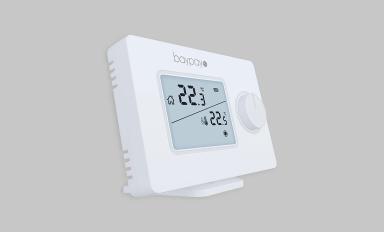
Baypayo Underfloor Heating Room Thermostat
A room thermostat is a key component of a room-by-room underfloor heating control system.
Baypayo room thermostat solutions can be considered for both wired and wireless underfloor heating applications, depending on project requirements.
The thermostat monitors room temperature and communicates the heating demand to the control system.
For multi-room residential projects, room thermostats can be used together with thermal actuators to control individual heating zones.
Baypayo Flow Meter Manifold
The underfloor heating manifold distributes heating water to individual circuits.
A flow meter manifold also allows the installer to monitor and adjust the water flow through each circuit.
This is particularly important where circuits have different lengths or different heating requirements.
A manifold should be selected according to:
- Number of circuits
- Pipe diameter
- Flow requirements
- Connection size
- Actuator compatibility
- Cabinet dimensions
Proper commissioning and hydraulic balancing are essential to achieve the expected system performance.
Baypayo Thermal Actuator
A thermal actuator provides automatic control of an individual manifold circuit.
The actuator receives a signal from the room heating control system and opens or closes the corresponding circuit.
The operating sequence can therefore be summarized as:
Room Thermostat → Control System → Thermal Actuator → Manifold Circuit
This makes the thermal actuator an important part of room-by-room underfloor heating control.
Baypayo Two-Way Motorized Valve
A two-way motorized valve is used to automatically control water flow in hydronic heating systems.
Depending on the system design, motorized valves can be used in underfloor heating applications, Heat Interface Units and other hydronic heating circuits.
Valve selection should take into account:
- Flow rate
- Pressure drop
- Pipe size
- Fluid temperature
- Control signal
- Connection type
The correct valve should always be selected according to the hydraulic and control requirements of the application.
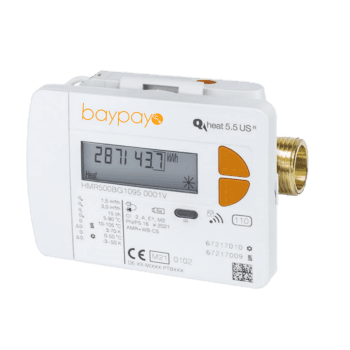
Baypayo Heat Meter
A heat meter is used to measure thermal energy consumption in a heating system.
In central heating applications, heat meters can be used to measure the energy supplied to individual apartments or defined heating zones, depending on the system architecture.
A heat meter typically works by measuring parameters such as:
- Heating water flow
- Supply temperature
- Return temperature
- Temperature difference
The measured data can then be used to calculate thermal energy consumption.
This makes heat metering particularly important in residential developments where energy consumption needs to be measured individually.
Baypayo Underfloor Heating System Design
A successful underfloor heating project should be considered as a complete system rather than as individual components.
The design process can include:
Heat Load Calculation
↓
Pipe Layout
↓
Circuit Calculation
↓
Manifold Selection
↓
Flow Rate Calculation
↓
Hydraulic Balancing
↓
Room Thermostat Selection
↓
Thermal Actuator Selection
↓
Control System
↓
Heat Source / HIU Integration
↓
Heat Metering
↓
Installation
↓
Commissioning
This approach helps ensure that the components work together as one heating system.
Underfloor Heating Installation and Commissioning
Installation quality has a direct impact on system performance.
The heating pipes should be installed according to the approved design.
The manifold should remain accessible for inspection and maintenance.
Before the floor is permanently covered, the pipework should be checked and pressure tested according to the applicable installation procedure and manufacturer's requirements.
After the system has been installed, the installer should verify:
- Pipe circuits
- Manifold connections
- Flow rates
- Thermal actuators
- Room thermostats
- Wiring
- Pump operation
- Control signals
- System pressure
The system should then be commissioned.
Technical Support and After-Sales Service
Underfloor heating systems are installed beneath the floor, so professional installation and reliable technical support are important.
Once the screed and final floor covering have been installed, access to the heating pipework becomes limited.
For this reason, components such as manifolds, actuators, thermostats and control equipment should be installed correctly and remain accessible where required.
Baypayo's approach to underfloor heating solutions can include support across different stages of a project, from product selection and system design to installation, commissioning and after-sales technical support.
This can be particularly valuable for:
- Construction companies
- Mechanical contractors
- HVAC installers
- Residential developers
- Housing projects
- Central heating projects
- Villa projects
Underfloor Heating Maintenance
Hydronic underfloor heating generally requires limited routine maintenance, but the complete system should still be inspected periodically.
Components that may require inspection include:
- Manifold
- Flow meters
- Valves
- Thermal actuators
- Room thermostats
- Circulation pump
- Filters
- Control equipment
- System pressure
If one room does not heat correctly, the problem may not necessarily be the pipework.
Possible causes can include:
- Incorrect flow adjustment
- Air in the circuit
- Faulty actuator
- Thermostat problem
- Pump problem
- Hydraulic imbalance
- Control wiring issue
Systematic troubleshooting is therefore preferable to immediately assuming that the underfloor heating pipe has failed.
Common Underfloor Heating Installation Mistakes
Designing Only According to Floor Area
A 100 m² house does not automatically have the same heating requirement as another 100 m² building.
Heat loss calculations should be performed.
Ignoring Insulation
Poor insulation can reduce the effectiveness of the heating system.
Incorrect Pipe Spacing
Pipe spacing should be determined according to heat load and system design.
Failing to Balance the Manifold
Different circuits require different flow rates.
Incorrect Thermostat Location
A thermostat should not normally be placed where direct sunlight, drafts or another heat source can distort the measured room temperature.
Installing Excessively Long Circuits
Very long circuits can increase hydraulic resistance.
Ignoring Floor Covering
The thermal resistance of the final floor covering can influence heat output.
Adding Controls Too Late
If room-by-room temperature control is required, the control infrastructure should be considered during the design stage.
Is Underfloor Heating Right for Your Home?
Underfloor heating can be a suitable solution for:
- New houses
- Villas
- Apartments
- Residential developments
- Hotels
- Commercial buildings
- Central heating systems
- Heat pump installations
- Low-temperature heating systems
It is particularly attractive when the building is being constructed from scratch because insulation, pipe layout, floor construction and control infrastructure can be designed together.
For an existing property, the feasibility of installation should be evaluated according to the existing floor structure and available floor height.
How to Choose an Underfloor Heating System
Before choosing an underfloor heating system, consider the following questions.
What Is the Heat Source?
Is the building heated by:
- Boiler
- Condensing boiler
- Heat pump
- Central heating
- District heating
- Heat Interface Unit?
What Is the Heated Floor Area?
The actual heated floor area should be determined rather than simply using the gross building area.
How Many Rooms Are There?
The number of rooms affects the number of heating circuits, manifold outlets, thermostats and actuators.
Is Individual Room Control Required?
If yes, the system should be designed with room thermostats and thermal actuators.
Wired or Wireless Thermostats?
Wired thermostats can be attractive for new construction, while wireless thermostats can simplify retrofit installations.
Is Hydraulic Balancing Required?
A flow meter manifold can make balancing and commissioning easier.
Is Heat Metering Required?
Central heating projects may require individual heat measurement depending on the building and metering arrangement.
Is Technical Support Available?
Technical support, commissioning and after-sales service should also be considered when selecting heating equipment.
Conclusion
An underfloor heating system is much more than a network of pipes installed beneath the floor.
A successful system combines:
Heat Load Calculation + Pipe Layout + Thermal Insulation + Underfloor Heating Manifold + Hydraulic Balancing + Room Thermostats + Thermal Actuators + Heat Source + Heating Controls + Professional Installation + Commissioning
When properly designed, underfloor heating can provide comfortable heat distribution, room-by-room temperature control and efficient low-temperature operation.
Compared with traditional radiator heating, it can offer advantages in terms of floor-level heat distribution, interior design flexibility and compatibility with low-temperature heat sources.
The cost of a 100 m² underfloor heating system cannot be determined from floor area alone. The number of rooms, pipe length, manifold configuration, insulation, controls, actuators, installation, screed, heat source and metering requirements can all significantly affect the final cost.
For residential developments and central heating projects, Baypayo's product portfolio can provide solutions covering different parts of the system, including Heat Interface Units (HIUs), room thermostats, flow meter manifolds, thermal actuators, two-way motorized valves and heat meters.
The most important point is that an underfloor heating project should be designed as a complete system. Selecting each component according to the actual heating requirement, hydraulic conditions and control strategy helps create a more reliable and comfortable heating installation.